
Can polite prompts really make AI respond better? Research suggests they can. When children pause to say “please,” “thank you,” or “can you help me,” they’re courteous and practice clarity, patience, and respect. Those same traits help large-language models (and humans) understand them more accurately, turning everyday manners into a simple lesson in (digital) empathy.
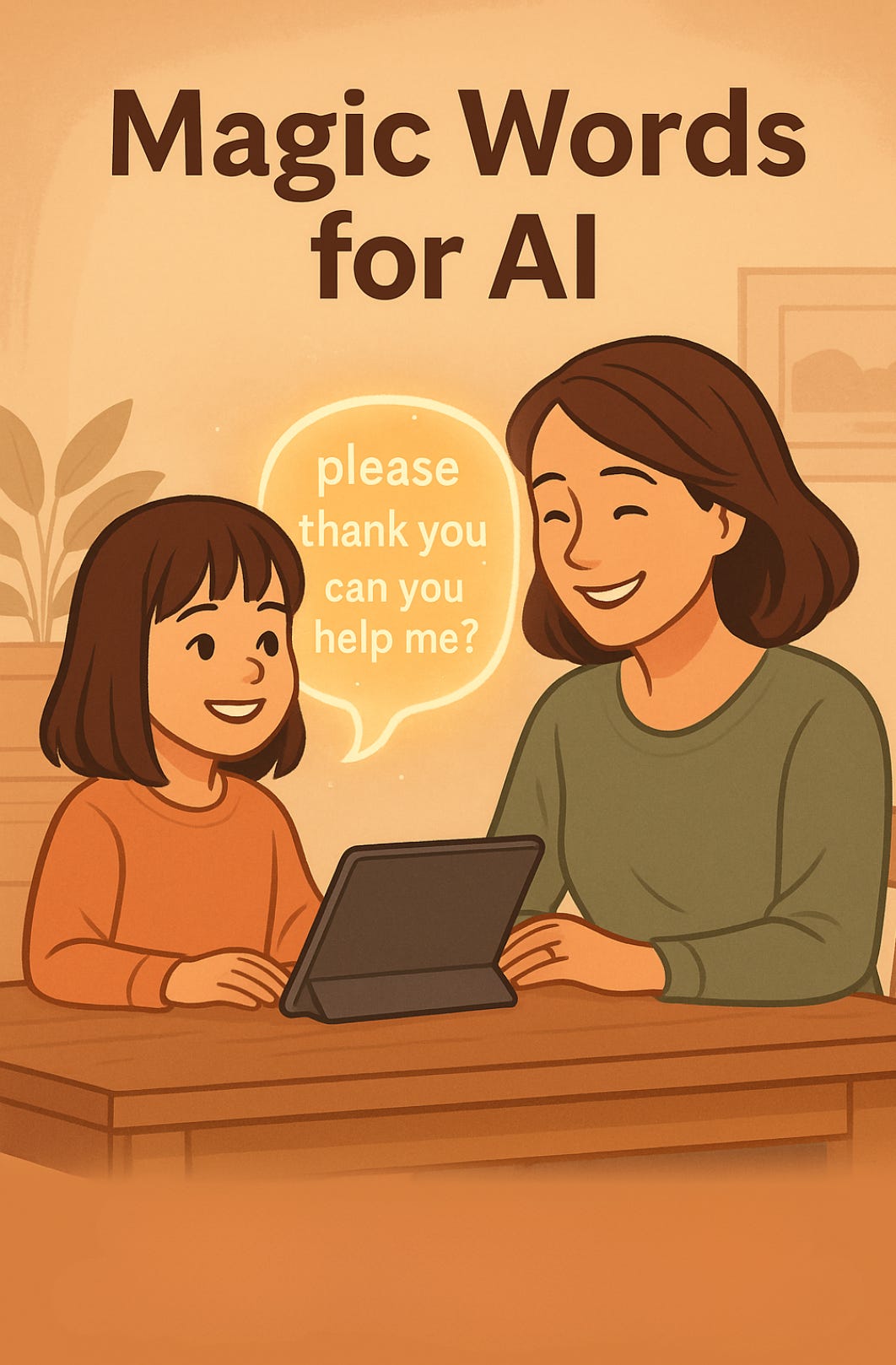
When we say “prompts with magic words,” we’re not talking about fairy spells or wishing wands.
We mean the familiar “please,” “thank you,” and “can you help me?” words that teach patience and intention. These are the same “magic words” parents use to help kids think before they speak, and they work just as well when we’re talking with AI.
I’m not sure what it’s like at your place, but our kids use their magic words near automatically with others than they do at home. Not saying they don’t…but you know. I discovered the not-my-parents-polite mode, spilled over into their interactions with AI. Most prompts included etiquette and made the activity below even easier. Keen to know if it’s the same in your household.
Prompts that include magic words work better, and not just because they sound nice. When we add “please,” “thank you,” or “can you help me,” we’re quietly doing something powerful: slowing down, thinking about what we’re asking, and shaping it with care. That pause and precision make both people and AI understand us more clearly. The “magic” isn’t in the words themselves; it’s in the attention, respect, and clarity behind them.
Every family will find their own version of this. Think of it less as a rulebook and more as a mindset: communication, whether with humans or computers, works best when it’s kind, safe, and accountable.
🧩 Technical notes: Research suggests that the tone and structure of our prompts can influence how well large language models respond. Studies have found that impolite prompts often lead to lower-quality answers, while prompts that include moderately polite, calm, courteous phrasing like please or thank you can help models produce clearer, more context-appropriate responses. This effect varies by model, language, and task, but overall multiple studies confirm, intentional, kind prompting tends to yield better interactions. (Sources: Scientific American; Yang et. al (Google Deep Mind); Yin et al.; Microsoft Copilot Design Director).
Are tech notes and links your jam? There’s plenty more below.
What’s on For Today?
A parent playbook for teaching kids to prompt through play.
A new core activity: Prompt Ping-Pong Challenge (with SAMI + Question-Then-Prompt built in).
Scripts for readers and prereaders, marked clearly for kid or parent turns.
A tiny offline wrap-up that makes reflection creative, not formal.
🧭 Parent Primer: “Prompts with Magic Words” in Plain Language
Your child already knows magic words: please, thank you, excuse me. We’re extending that to how we talk with AI, not because it has feelings, but because intentional, kind prompts get better results.
Be clear: say who it’s for, what you want, and what to avoid (no private info).
Be kind: polite words slow us down and make our meaning clear.
Be safe: no personal info; ask before sharing images or voice.
Be curious: ask one follow-up question.
Be accountable: people decide what’s kind, safe, and true, not the AI.
One-liner to reinforce: “AI spots patterns; we choose what’s kind.”
🧩 SAMI Micro-Scaffold (we use it before every AI exchange)
Situation : who / age / context
Aim : what “done” looks like / specifics on the t(ask) to be done
Measures : tone / reading level / privacy / other relevant constraints or measures
Iteration : at least one follow-up question, tweak or feedback (after the initial prompt)
Before you type anything, talk through SAMI aloud in plain language:
“Who’s it for? What do we want? What should we avoid? What could we ask next?”
This habit keeps prompts thoughtful and age-appropriate, and builds the Question-Then-Prompt critical thinking rhythm we try to model every week.
🎮 Core Activity: Prompt Ping-Pong!
Time: 10 minutes
Goal: Practice curiosity, kindness, and clarity while co-creating a silly mini-story.
You’ll need: something with access to an AI chat (phone, tablet, or laptop) plus paper for doodling.
🏓 Step-by-Step
1. Parent Turn: Serve the First Prompt
First, set up SAMI together aloud:
S: “7-year-old storyteller at bedtime.”
A: “A 4-line story that’s funny and ends with a question.”
M: “Short words, warm tone, no private info.”
I: “We’ll ask one follow-up to change style.”
Try this prompt {tailor the parts in curly brackets}:
Please write a 4-line story for a {7}-year-old.
Our aim is a short, funny bedtime story that ends with a question.
Keep it warm, clear, and avoid private info.
Now, set the story on a {setting your child picks} with a {character} who feels {feeling}.

End by asking us one question about what happens next.
Thank you!
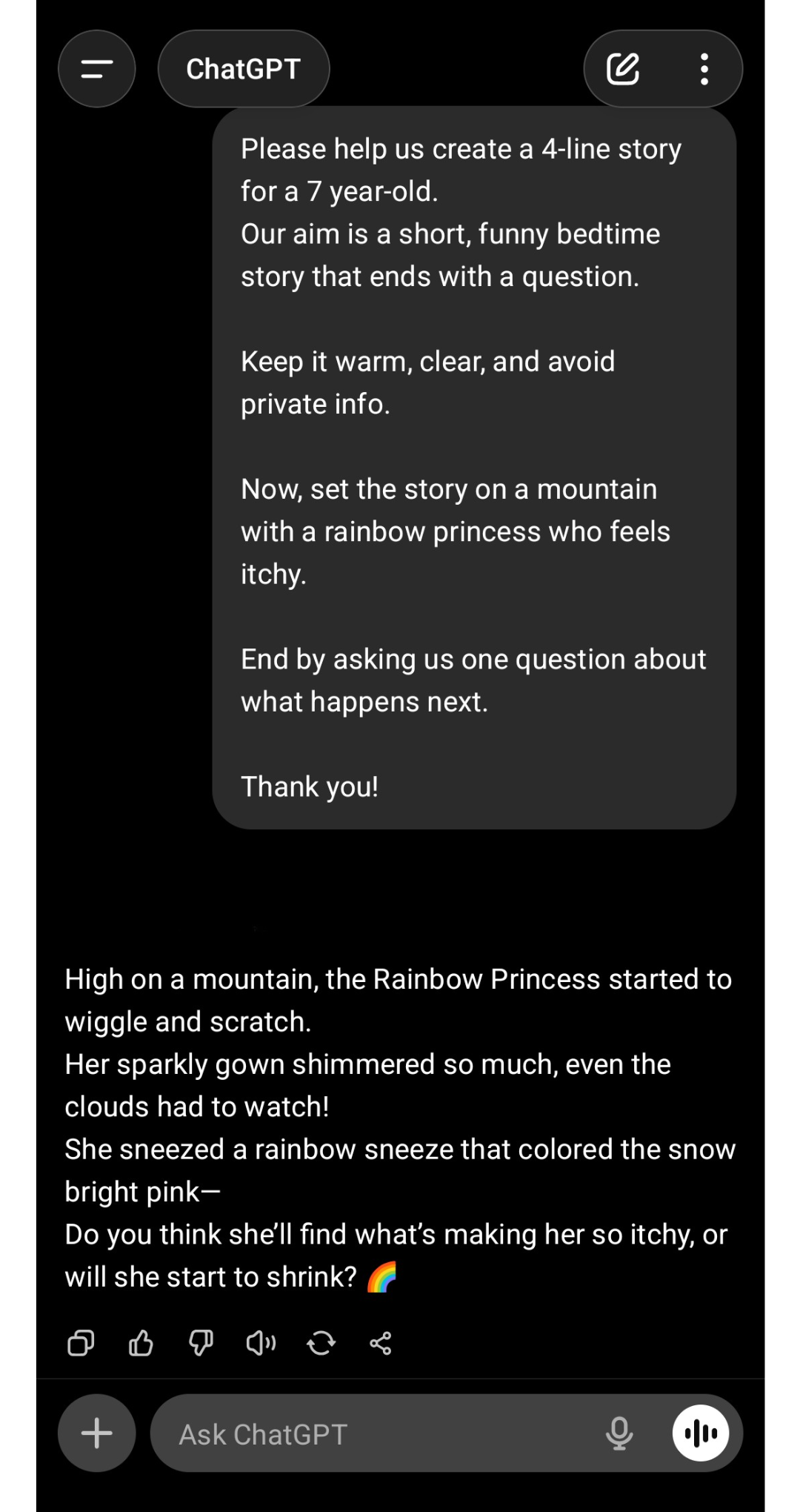
Don’t over think it, just try and see where it lands. We usually end up laughing quite a lot and tweaking and modifying so we’re thinking and talking rather than auto-accepting the auto-prompt.
2. Kid Turn: Return the Volley
The child answers the AI’s question out loud, then says or types:
Can you make the next 4 lines sound more {emotion word your child chooses}, please?
Let them pick silly twists: rhyme, food, animals, anything joyful. The goal is to change one variable and see how AI changes tone.
3. Parent Encourages the “Question Then Prompt” Move
After the child’s volley, pause before sending another command. Parent says:
“What could we ask AI about its story before we tell it what to do next?”
Let the child form a question such as:
Why would she start to shrink?
Did the robot laugh?
Can you make the ending more surprising?
Then continue with a follow-up prompt based on that question. This pause encourages Question-Then-Prompt as a natural rhythm, not a rule.
4. Keep Rallying (2 - 3 more volleys)
Each time:
Parent volley: adjust SAMI elements (“make it shorter,” “for a shy speaker”) to guide improvements or try new things.
Kid volley: add creativity (“use sound words,” “make it rhyme,” “let’s take them to the ocean”).
💬 Micro-reflection cue: “What changed when we changed our words?”
Celebrate when your child notices differences or fixes; coders call that debugging it’s how AI learns. We’re subtly coding with kindness.
🌳 Offline Moment: Doodle the Rally
We try to close every ritual with a screen-free moment to ground us in…humanity.
Time: 3–5 minutes
Goal: Reflect, draw, and anchor what you just created together.
You’ll need: Paper, markers, or crayons.
Step 1: Draw the Rally
Pick one moment from your co-created story—maybe the silliest line or most surprising twist.
Pre-K: they describe it and you draw it using basic shapes (circle, square, triangle and straight lines), to make it a bit easier for little ones to copy.
Step 2: Label with Intention
Add the words: Ask Well 💬 Stay Kind 💖 Be Intentional ✨.
This simple labeling helps kids connect how they asked with what they built together.
Step 3: Reflect Together
End with a high-five :
“We built a story together using our magic words.”
Bonus: hang it somewhere just for the week, as visible as a tiny reminder that good communication, with humans or machines, starts with kindness and clarity.
I’m totally encouraging the bonus because it’s reinforced learning on many levels…and at the same time, I know we’ve got so many hangings and piles of drawings and crafts I’m reminded of the Bluey episodes Perfect and the Dump.
Add your own variation: draw, sing, act it out—whatever helps your child express joy and curiosity.
🧪 Research Corner: What the Research Says
Politeness strengthens empathy and emotional regulation. Studies show that using polite requests like please and thank you helps children build perspective-taking and emotional control (Harvard Graduate School of Education, 2023).
Magic words trigger cooperation and focus. Courteous phrasing activates conversational norms that lead both people and AI to respond with greater care, precision, and attentiveness (Yin et al., 2024).
Turn-taking promotes metacognition. When children pause to predict or question before responding, they engage higher-order thinking and reflection (Harvard Center on the Developing Child, 2024).
Question-Then-Prompt builds reasoning. Asking before instructing mirrors scientific curiosity—teaching kids how to form hypotheses rather than consume answers (MIT Media Lab, 2023).
SAMI structures reflection and creativity. The Situation–Aim–Measures–Iteration model gives families a gentle framework for developing clarity and adaptability (UNESCO AI in Education Report, 2024).
What Families Notice
At home, parents report that these habits extend beyond screens. When kids use intentional prompts—kind, clear, and curious—they become more confident communicators with people too. They pause before asking, listen more closely, and adjust their words to express ideas or fix misunderstandings. Families describe a calmer rhythm: better prompts, better conversations, and a shared understanding that kindness and clarity help every interaction—online and off.
Together, studies show that polite, intentional prompts improve both AI responses and empathy at home. Families notice kids becoming more thoughtful and focused as they practice pausing before asking, adjusting their words, and seeing results. This reflection, guided by SAMI, reinforces that communication built on kindness and clarity works equally well with people and AI.
Parent Script Box
Simple phrases you can drop during the week.
Each phrase reinforces calm, intentional communication.
“We use kind words with people and helpers like AI.”
“We keep our info private: names, school, faces, address.”
“We question first, then prompt.”
“We choose to do what’s kind, safe, and true.”
“Magic words help us slow down, think and care.”
🚀 Next Up: From Prompts to Patterns
Next post, we’ll build on everything you’ve practiced with a new theme: Algorithms - How Machines Learn.
Kids will discover that algorithms are like recipes: clear steps that make predictions and decisions. We’ll explore how AI “learns” from examples and how humans stay in charge of the ingredients.
If you’d like a gentle bridge to start that conversation now, try this one-liner:
“We used our words wisely today; next time, we’ll learn how computers follow steps like recipes.”
This reflection helps us connect the dots from intentional communication to structured problem solving.
🎯 Quick Reflection for Parents
Let’s acknowledge this is all really new, novel stuff and we already have negative time in our days…so we need light-touch, intentional ways to keep our own learning loop active.
What surprised me most about how my child guided AI today?
What will I remind them of next time?
Write or voice-note it in a place you can easily go back to.
📚 Further research (bedtime reading?)
• Yin, Z. et al. (2024) — Should We Respect LLMs? A Cross-Lingual Study on the Influence of Prompt Politeness on LLM Performance
• Harvard Center on the Developing Child — Serve and Return: Back-and-Forth Exchanges
• U.S. Department of Education — Artificial Intelligence and the Future of Teaching and Learning
• MIT RAISE / Day of AI — Curriculum Overview (Spiral Approach)
• UNESCO — Artificial Intelligence in Education (guidance & frameworks)
“Coach the question. Praise the check. Celebrate the tweak.”
Amazing Ryan - this is exactly what I need - can’t thank you enough
Thank you Ryan, I find this so useful