
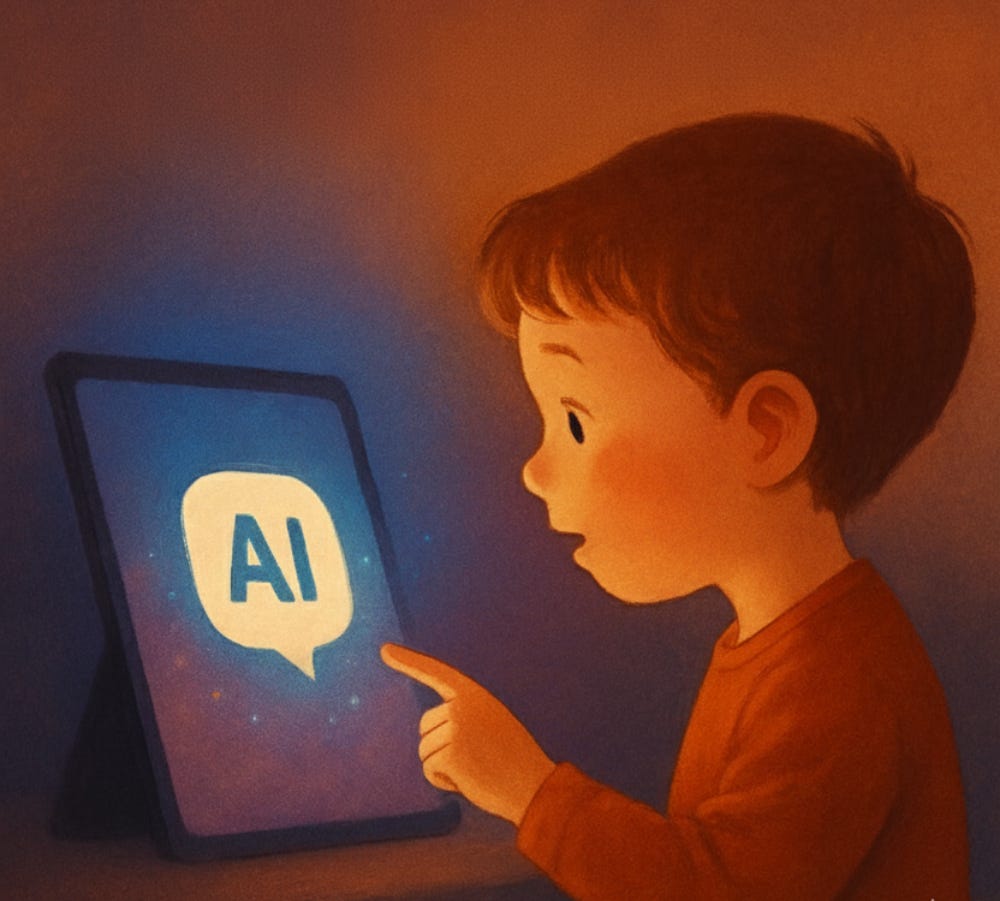
“Is it alive?”
The tablet went black, then a soft misty orb pulsed gently on the screen in my child’s hands. AI was “talking” to us about atoms and states of matter. “Is it alive?” she whispered.
It wasn’t her first encounter either, but I get it. I have those half magic, half mystic moments where I’m left awed, and sometimes, cautious.
This week, we slow down and name what AI is (and isn’t) in calm, child‑friendly language so curiosity stays high.
💡 The setup
Start with wonder, not fear. Framing AI plainly reduces mystique and helps kids engage thoughtfully over time.
Spiral learning. Returning to the same big idea in small weekly bites creates stronger connections than a heavy info load.
Your values lead. Naming what AI is creates a chance to reinforce kind, safe and thoughtful use (want to create Family AI Rules?).
Many of us grew up with technology that didn’t need much explanation. Now, our kids, as AI natives, are growing up inside a new paradigm, and that can feel both exciting and unsettling. These small conversations aren’t about embracing AI or deciding how we feel about it yet. They are about understanding and naming what’s here, so we can guide our kids with clarity and care.
🧩 A quick family game : Natural vs. Artificial
Time: 8–12 minutes
Aim: help kids feel the difference before we talk about AI.
1) Start with a tiny story
Kids are naturally curious about what’s “real” vs. man-made. Artificial basically means made by humans, while natural means made by nature.
For example, a tree growing outside is natural, but a wooden chair in your kitchen is artificial – people made it from that tree.
Artificial things are made with human skill and creativity to serve a purpose or solve a problem. “Artificial” comes from Art and Fex, two Latin words, that mean “skill” and “to make”.
Parent script: “The world is full of things nature made like trees, rain, puppies. Then people started making things too: chairs, robots, apps. Let’s see if we can tell which is which.”
2) Family sorting game (5 minutes)
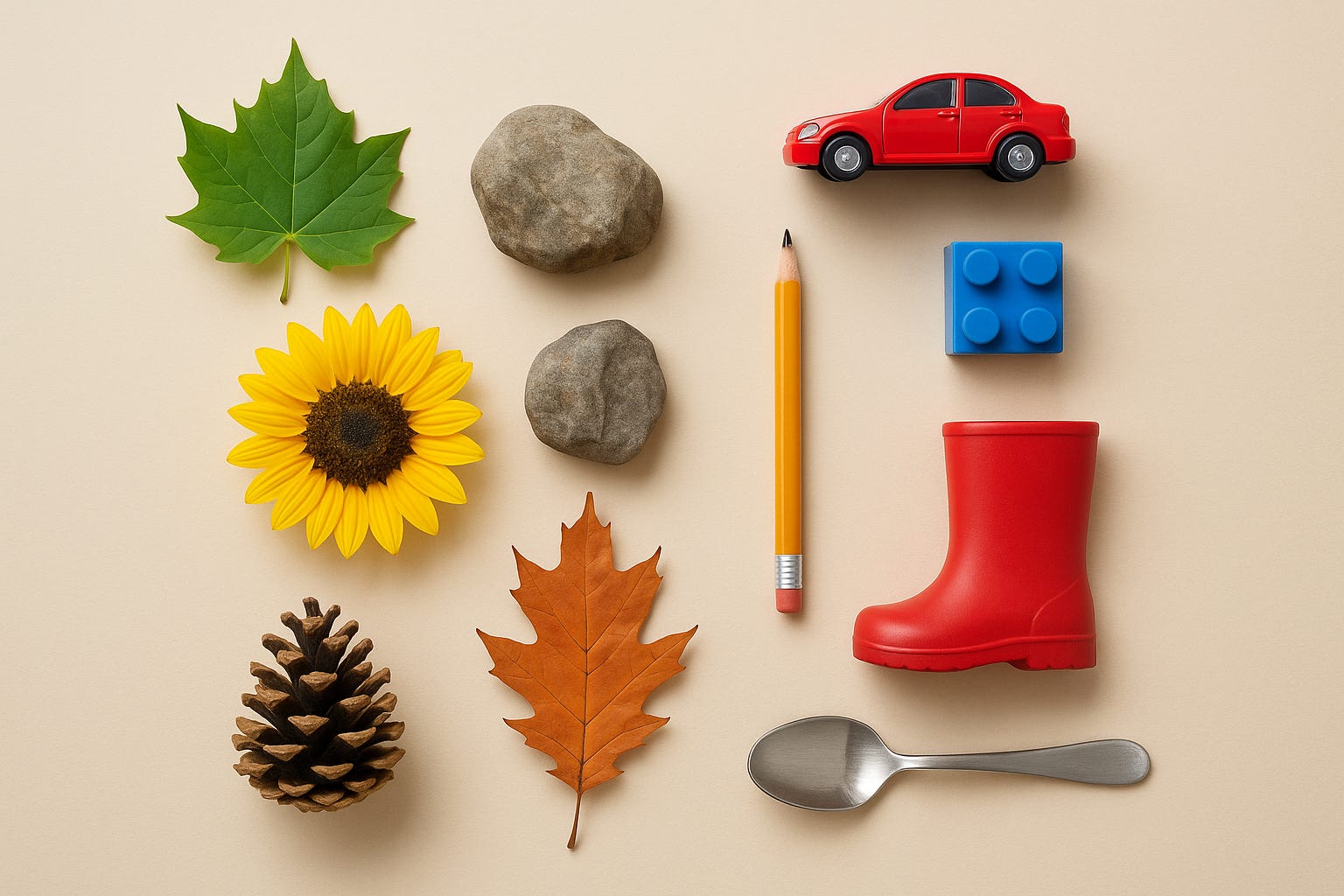
“If nature made it, it’s natural. If people made it, it’s artificial, or made by people.”
Walk around your home or yard and point, ask your child: “Is it Natural or Made by people?”
🌳 Tree ———-- 🪑 Chair
🍎 Apple ——— 🧃 Juice box
🐶 Puppy ——-- 🤖 Robot vacuum
☁️ Clouds ——- 📱 Phone
Help kids notice that nature is forever awe-inspiring, and many artificial things were built on purpose.
3) Bridge to AI (name it simply)
Artificial intelligence (name the app you use) is another thing people made but instead of using wood or metal, they used data (lots of examples) and code (instructions).
Simple idea: AI is a computer program that spots patterns in lots of examples and makes fast guesses. It doesn’t have feelings or a body.
Helpful swaps:
program = instructions a computer follows (I often find myself saying “app” it’s technically imperfect but very relatable)
examples = pictures, words, sounds it practiced on
pattern = things that look or act alike
At home you might notice AI in chat, video suggestions, spell check, auto captions, or voice assistants.
Tiny script for prereaders:
Parent: “Robot helper—real or pretend?”
Child: “Pretend?”
Parent: “Yep. A tool that guesses using patterns. You know patterns like 1, 2, 3… [wait for them to respond], yes! You got it! Robot helpers knows patterns too!”
4) Where does AI show up daily?
Some common apps kids may interact with AI (unknowingly) include Netflix, Spotify, Google Photos or Siri. Some common devices phones, smart speakers or cameras all use AI. And of course, using AI chat interfaces like Claude, ChatGPT, Gemini, DeepSeek or Grok.
Reinforce: they don’t feel or think like us; they learn patterns and try to guess the best answer.
🗨️ Calm answers to big questions
I remind myself, we don’t need to know all the answers. At home we try to own it when we don’t know and then give it your best shot. Research shows your reassuring tone / delivery is probably more important as kids (most people?) often remember the feeling more than the facts.
Is it alive? No. It’s a computer program people made. It doesn’t have feelings.
Why does it talk like a person? People added a friendly voice so it’s easy to use. There’s a program (app) underneath.
What should I say? We keep private things private. We don’t share full name, address, school, or photos without a grown‑up. If a tool asks, we say no or ask for help.
Can it make mistakes? Yes. It guesses. That’s why we check together each time (just one small thing, to reinforce the habit).
Can it do my homework? As a helper, not a substitute. I’m sure it’s age and school dependent, in all cases we’d tell the teacher if we used it.
Can it draw like me? It mixes patterns it learned from lots of art. Your drawing shows your choices and feelings. That’s special.
🔎 Tonight (pick one 5‑minute close)
How it’s made. Pick one made thing (table, backpack, app icon). Ask: “What did people use from nature to make this?” Name two materials (wood, glass, metal) and one step (cut, sew, program).
Helper Moments List. Write or draw three moments when a helper would be useful (school morning, library, chores). Add one kindness rule it must follow.
I Spy, AI! On your next walk or drive try: “I spy something that guesses what to listen/watch next” (e.g. Spotify / Netflix). “I spy something that draws creative pics” (ChatGPT…no you😋, GPT helps build what’s in your creative mind!)
This week I intentionally attempted to explain AI without having you need to prompt AI…but if you’re itching to have your littles jam with your favorite AI assistant…we’ve played the “is it Natural or Made by People” game using GPT. Just remember to guide your AI to make the interaction kid appropriate - here’s a link to the SAMI scaffold we talked about last week to setup your first prompt.
Let me know how your adventure unfolds.
Up next
We’ll peek inside how machines sense the world and design some cool bots.
Plain words build brave kids.
When we demystify AI, we make room for curiosity and thoughtfulness.
Love the concept of the spiral learning - sticking to one topic and breaking it up 👏
This great - thank you - I am going to try this tonight