
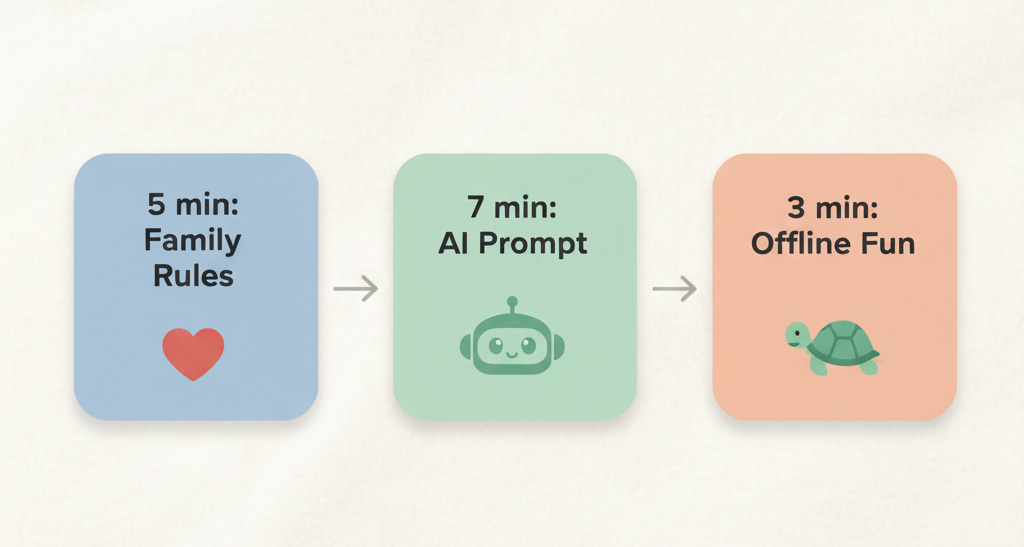
TL;DR: Do this today: AI Rules (5 min) → Kid prompt (7 min) → Offline sticky (3 min). That’s it.
A 15 Minute Family AI Connect : Safety, Boundaries, and a Simple Win Today

Image Credit: Me…and Nano Banana
A short, hands-on guide for parents raising kids in the age of AI — starting where curiosity and caution meet.
Who this is for: Busy parents who want their kids to benefit from AI, responsibly, without the drama.
Outcome today (≤15 min): Set house rules, try a first prompt together, and finish with an offline activity.
How do I introduce AI to my child (ages 3–13) safely in 15 minutes?
We’re raising three AI natives: ages 3, 5, and 7. We follow the research, the experts, and the endless parent feeds. We try, a lot. And yet, like most parents, we still wonder if we’re doing it right (and believe we should be doing better :)
What surprised us most is how little research exists around raising kids with ai, like a real field guide for helping kids understand, utilize, and guide AI. Unlike coding, the nuances that matter most here aren’t technical. They’re developmental — cognitive, social, emotional, and about a child’s emerging sense of self. And if AI is anything near as impressive and pervasive as most believe it will be, our ai natives will soon be responsible for stewarding this ai future, or at the very least, living it.
Over this past year, I started compiling the most important research on AI technology, responsible use of AI, and early childhood studies to build the parent guide I wish we had.
Let’s jump in. No jargon. No context needed, just 15mins (timed with my 7-year-old).
AI used to be Under the Hood at every big tech company but in the last couple of years… it’s kinda Everything, Everywhere All at Once.
Your edge is shared learning and clear boundaries.
Your kids mirror you. A tiny weekly ritual beats a big lecture.
Our north star: curiosity with guardrails.
Kids learn to ask better questions and check answers.
Approachable Family Rules for AI (5 min)
Family AI rules are simple, kid friendly guidelines for kindness, privacy, permission, and checking facts together.
Our Family AI Rules (v1.0)
Kindness: We use kind, respectful words.
Privacy: We avoid private info (full name, school, address, ID photos, live location).
Permission: Ask a parent before using AI for images or voices.
Check: If AI gives a fact, we verify it together.
Stop: If something feels off, we pause and talk about it.
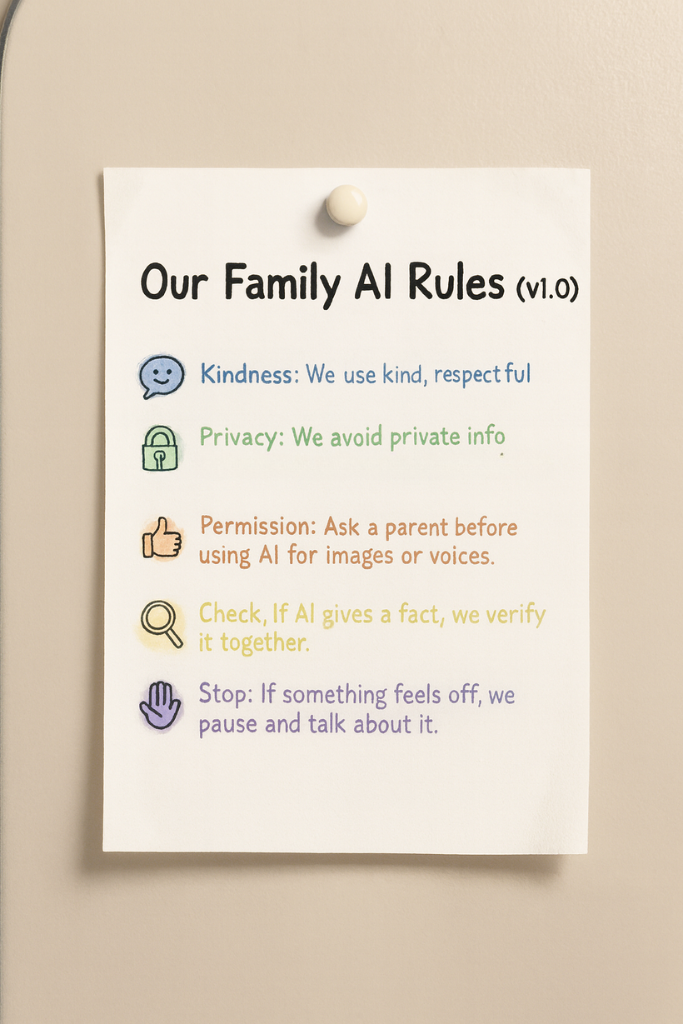
Make it yours: Add a couple of family specific rules in your own words (e.g. “screens in shared spaces” or “timers for turns”). Date it and call it your Family AI Rules. Personal pref: I chose “Rules” because I find it easier to recall acronyms (FAIR) but you might like Charter or House Rules.
“Coach the question. Praise the check. Celebrate the journey.”
Try this side-by-side prompt (7 min)
Reading level: first grader friendly
Parent script:
“Let’s use AI like a helper for our curiosity. We’ll try to ask clear questions, keep our info private, and double check one thing together. Ready to try this?”
Prompt:
“We’re making a two minute show and tell about sea turtles. Give us three surprising, kid friendly facts a first grader can explain. Keep sentences short and lovely enough to share with Grandma. Avoid private info. Then give us one question we can ask Grandma about sea turtles.”
Optional: Verbal Prompt (for prereaders):
“We’ll say our question out loud. Please answer with one or two short, kid friendly sentences a first grader can repeat. Keep it lovely enough to share with Grandma and avoid private info.”
SAMI Mini Scaffold
Use this quick frame to guide any prompt:
Situation: who, age, context (e.g., “first grader, shy speaker”).
Aim: what “done” looks like (e.g., “3 facts + 1 question”).
Measures: reading level, tone, avoid private info.
Iteration: after the initial prompt, practice completing the loop by providing one question / specific piece of feedback to improve the next response. This encourages critical thinking instead of auto-accepting the suggested next prompt.
Question then Prompt
Encourage critical thinking as the default way to engage
vs. auto-accepting the suggested next prompt
Offline reinforcement (3 min)
Child draws a tiny sea turtle on a sticky note and writes one fact.
Prereader tip: If writing is hard today, say the fact while a parent writes it, or draw it together.
Stick it under “Our Family AI Charter.”
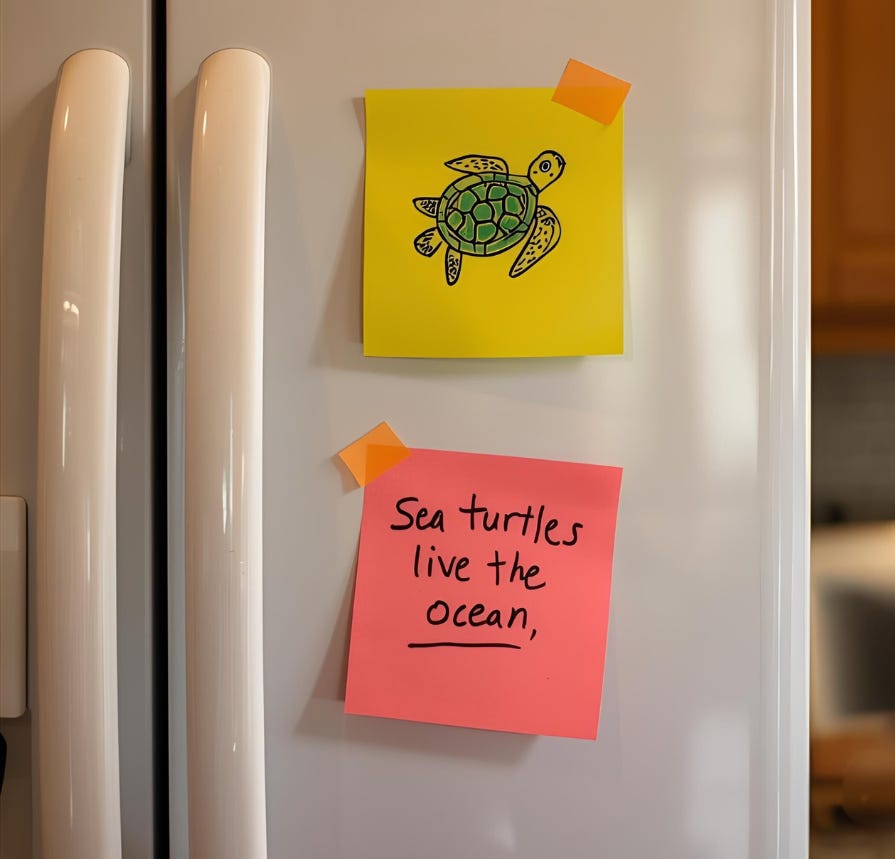
Image: Nano Banana - I’ll swap these with my fridge soon, two kids are done, one to go.
High five with your kid: You asked a great question, checked one thing together, and made a tiny turtle card.
Tiny challenge for the week
Kid challenge: Pick a new animal. Ask for one fun fact and draw it.
Parent helper: Create a simple three step checklist for your day. Use AI to make it friendly and quick.
End both with a sticker or checkmark.
My dream: tag @parentintheloop when you’re done
Micro FAQ
Too hard or easy: Change one SAMI setting like “shorter words” or “make it playful.”
Prereader: Child says it; parent writes or draws.
Weird output: Say “stop,” close it, and try a simpler question.
Homework: Yes, and…start small, with transparency. Think and write in their own words, then have “AI help brainstorm a specific piece.”
Images and avatars: Not yet. We’ll explore when and how in the coming weeks - think privacy, consent, biases etc.
Time sink guardrails: Use a timer and always end with something offline to complete the session.
Newsletter images : Unless credited, all images are created by me…with a mix of Nano Banana, ChatGPT, Claude and Canva.
Coming next
Demystifying AI for kids with playful ways to introduce core concepts like natural vs. artificial, or senses and sensors.
Thank you so much for reading. Let me know what resonated, and please share with someone who cares.
💥your little just set kind AI rules, asked a great question and made a fridge card.
I *love* this! Thank you for filling a concerning void with this insightful program. We are on the precipice of a major transformation in how we share, engage in, and understand our world with the Artificial Intelligence (AI) yet, ironically, adults have little information on how to proceed intelligently and safely. It’s a new frontier and we need to ensure our children navigate this uncharted path in such a way to set them up for success as future citizens and leaders of a new world that will most certainly be permeated with AI. Kids are exposed to technology at an early age and it is an integral component of their education. I’m following and will be doing this with my four and seven year-old girls. Thank you!!
Thanks Sharon, this is exactly how I feel. Also thanks for giving me my first comment 🙏